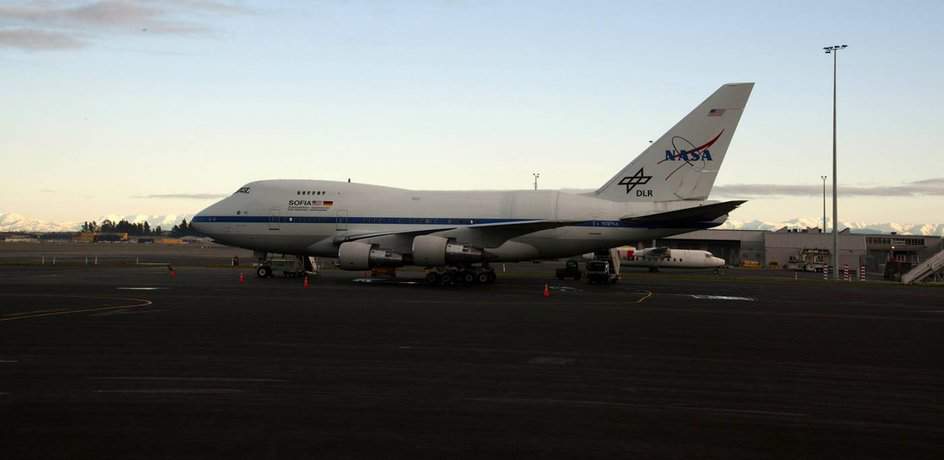
Photo - Photo NASA / Carla Thomas
NASA adapted a telescope infrared waves on a Boeing 747SP, the project's aim is to better study the space from the earth's stratosphere. The flying telescope began its fourth series of surveys on 03 February 2016. This operating period, known as Cycle 4 is a period of a year-long observing where Sofia is scheduled to hold today's 106 flights until January 2017.
"The 4th cycle program will hold more than 550 hours of observations," said Pamela Marcum, SOFIA Project Scientist at NASA. "We will study objects that cover the full range of astronomical topics, including planets, moons, asteroids and comets in our solar system; star and planet formation; extrasolar planets and the evolution of planetary systems; the interstellar medium and interstellar chemistry; the core of the Milky Way and normal and active galaxies nearby. "
To meet each flight mission, the Boeing 747SP flying at a higher altitude than 40,000 feet, where the air is already extremely thin and without water vapor, SOFIA has a telescope 2.5 meters in diameter, adapted to receive infrared light.
Many objects in space, such newborn stars emit almost all their energy in the infrared wavelength and are undetectable when considered in the context of visible light. In other cases, the clouds of gas and dust block the passage of infrared light when observed at sea level, but allows higher altitude view. The use of Sophia is slightly cheaper than keeping a telescope orbiting the earth, including the almost instant access to data, which speeds up the search process.
"During the third flight of the mission in February, the telescope spotted a young planetary system around the star visible to the naked eye, the Vega, which is only 25 light years from earth also was seen a star born at 1500 light years away, located near the Orion star, "said Eric Young, the Sofia project mission Director. He adds, "We also observed a hidden supermassive black hole behind thick dust clouds in the center of a galaxy is 170 million light years away."

